Read species imagery without inventing an identification
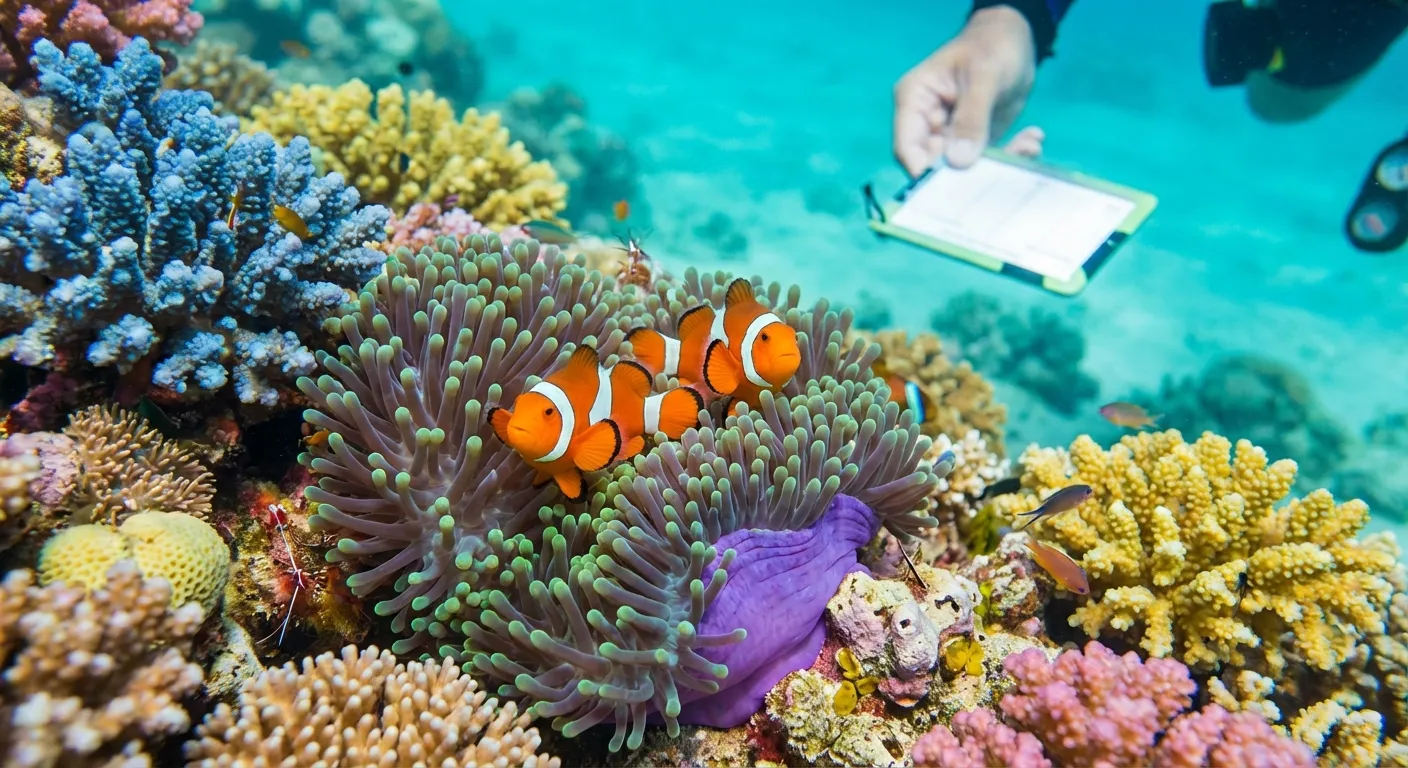
Illustrative scene, not a record of an editorial dive or a site-condition report.
An illustration and an identification are different
The images on this site illustrate reefs, marine life and fieldwork themes. They are not vouchers, verified species records or evidence that the editorial team observed a named organism at a named location. A common name in a caption can conceal several different organisms or an uncertain identification. Where an identification matters to a claim, look for a suitable source, the characteristics used and the uncertainty that remains. Do not infer a complete community inventory from a colourful scene or assume that every animal in a composite-style illustration belongs to one documented survey.
Keep the organism and the surrounding habitat in view
A reef account can involve living coral, other organisms and the physical setting, but a single image does not measure all of them. Ask whether a statement concerns one colony, one survey area or a much wider region. Keep that scale attached when summarising the source. The same principle applies to claims about recovery or damage: evidence about one subject should not silently become a verdict on the entire destination. We do not supply unsupported species counts, coverage estimates or a local restoration success rate merely because a photograph looks rich in detail.
Use the meaning of bleaching carefully
NOAA National Ocean Service describes bleaching in terms of stress and the loss of symbiotic algae from coral tissues. It also distinguishes bleaching from immediate death and notes that stress can have more than one cause. This is a reason to be precise with terms, not a way to diagnose every pale object in an underwater image. Follow the original source and an appropriate observation method when discussing an actual event. An educational explanation belongs beside its limits and should not be presented as a substitute for a field assessment.